 18+
18+
18+
18+
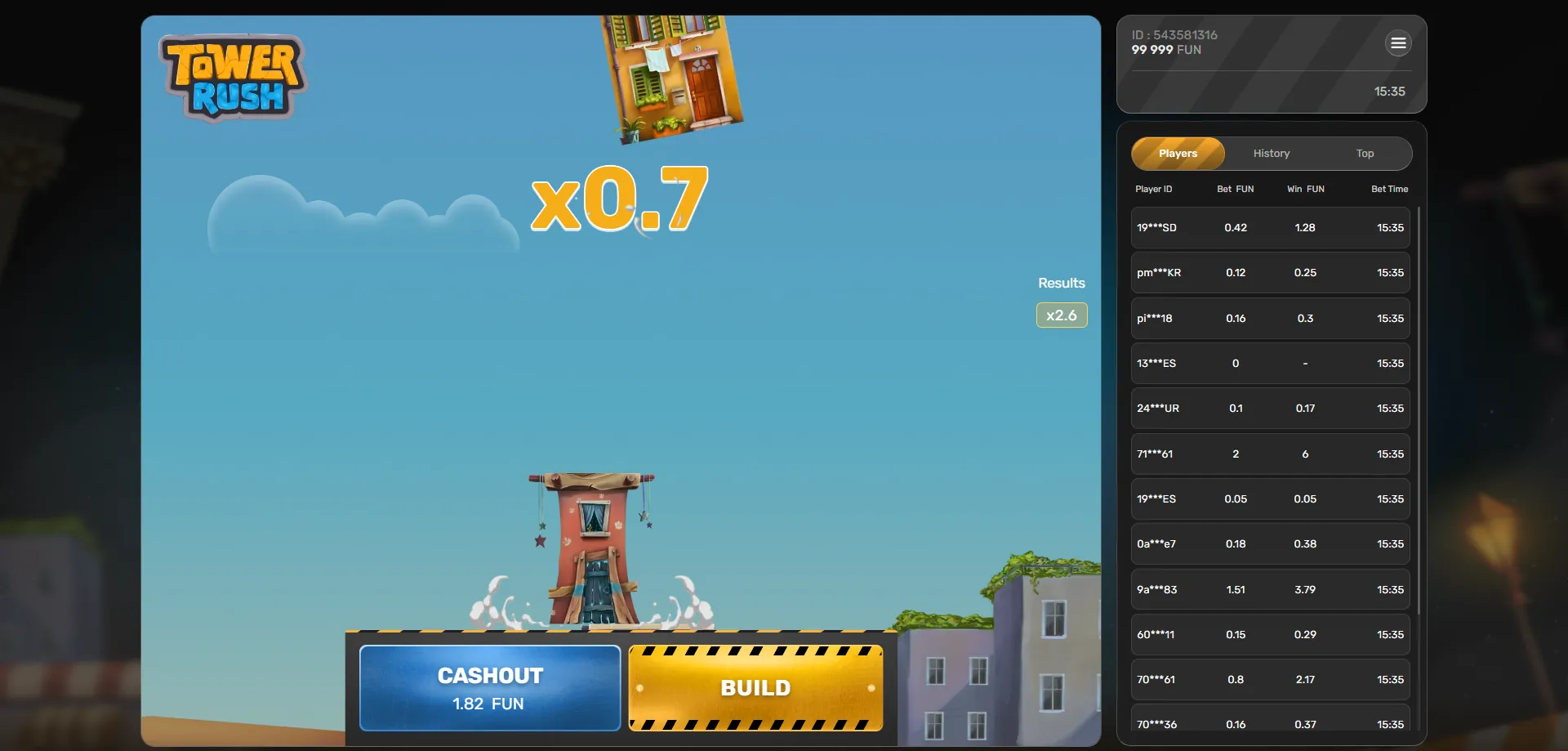
Tower Rush is a crash-format online casino game developed by Galaxsys. The concept revolves around a virtual tower that builds upward floor by floor, driving a multiplier higher with every step. Players must decide when to cash out before the tower collapses — a blend of timing, nerve, and strategy that distinguishes it from traditional slot machines. Searches for what is tower rush and tower rush kya hai reflect growing curiosity about the title, and for good reason: the format is fast, transparent, and engaging.
Tower Rush was developed by Galaxsys, a studio specialising in fast-paced, skill-influenced crash and turbo games for modern online casino audiences. Galaxsys is known for building provably fair mechanics into its titles and optimising them for mobile play globally.
The core concept is straightforward: place a bet, watch the tower rise, and cash out before it falls. The multiplier climbs as each floor is added. Wait longer and the potential reward grows — but so does the risk of losing your stake entirely if the tower collapses before you exit.
Where many crash games use aircraft or rockets as their visual metaphor, Tower Rush replaces that with a floor-building tower, adding bonus floor mechanics that are absent in most competitors. The 97% RTP and provably fair system also give it an edge in transparency.
Players are drawn to the tension of each round — the question of when to exit never gets old. The short round length, mobile compatibility, and INR support make it especially popular among Indian players who want quick, accessible gameplay without complex rules.
The game features a dynamic floor-building visual theme. A virtual structure rises in real time against a clean, modern backdrop. The graphics are optimised for performance on all devices, ensuring smooth animation without lag. The atmosphere is tense and focused rather than flashy.
The aim is to cash out at the highest multiplier you can achieve before the tower crashes. Each additional floor increases both your potential reward and your exposure to loss. Success depends on reading risk and acting with discipline.
The crash point is determined by a certified random number generator (RNG) before each round begins, so the outcome is fundamentally random. However, disciplined cash-out decisions, bankroll management, and use of auto cash-out tools introduce a genuine skill element that separates careful players from impulsive ones over time.
Yes. Tower Rush is fully optimised for Android and iOS. Android users can play through a mobile browser or download a dedicated APK from their chosen casino's website. iOS users access the game via Safari or Chrome without additional installation.
No download is required to play via a mobile or desktop browser. The game runs instantly through the casino's web platform. An optional Android APK is available at some casinos for a more native experience, but it is not compulsory.
Unlike slots, Tower Rush has no reels, paylines, or scatter symbols. There is no spin button and no fixed paytable. Every round is a live, real-time event where the player's timing is the only variable they control — making it far more interactive than spinning a slot.
Tower Rush suits players who enjoy fast-paced action, transparent mechanics, and games where their decisions matter. It also appeals to those who find slot machines passive and want a format that rewards focus and discipline. The low minimum bet makes it accessible to beginners, while high-multiplier potential attracts risk-tolerant players.
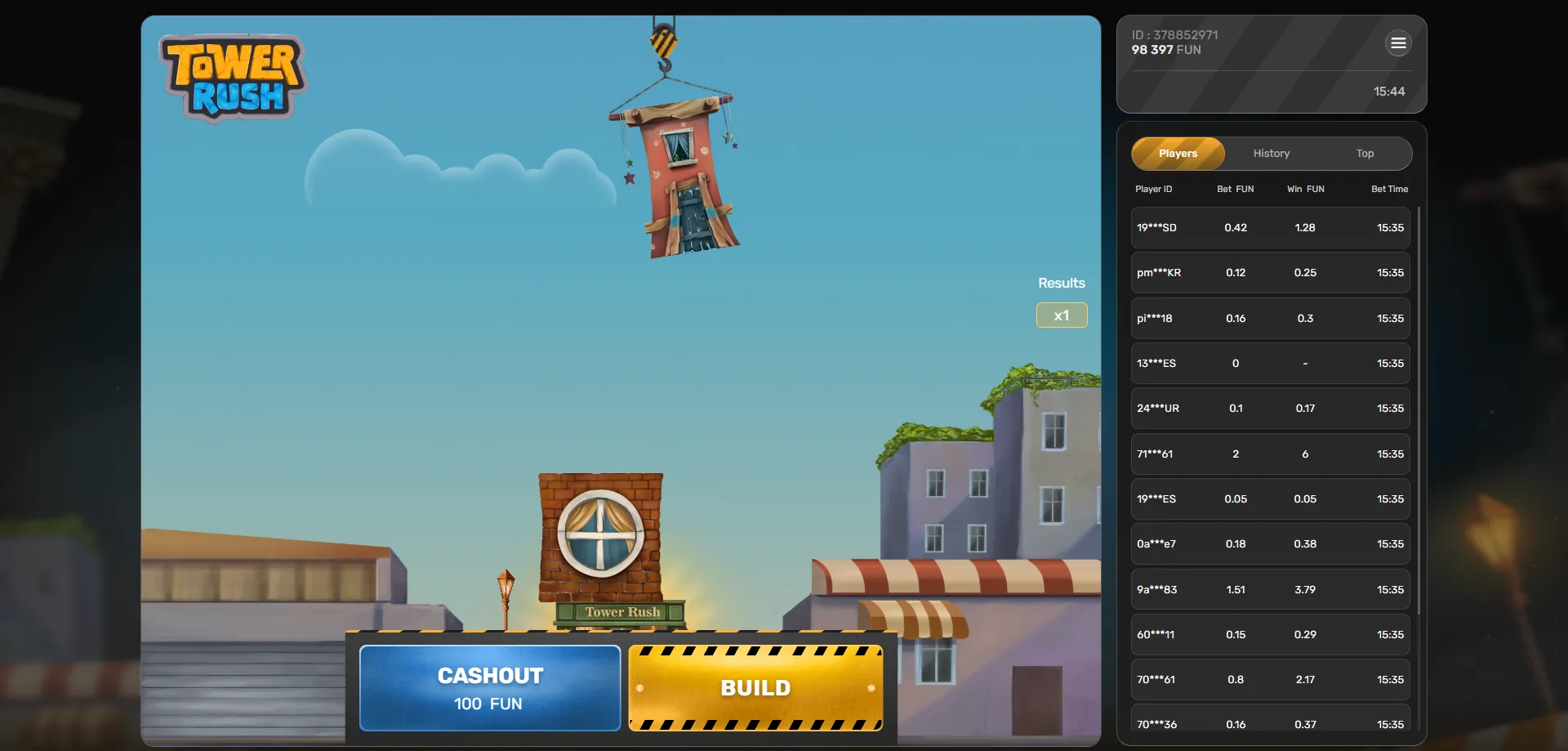
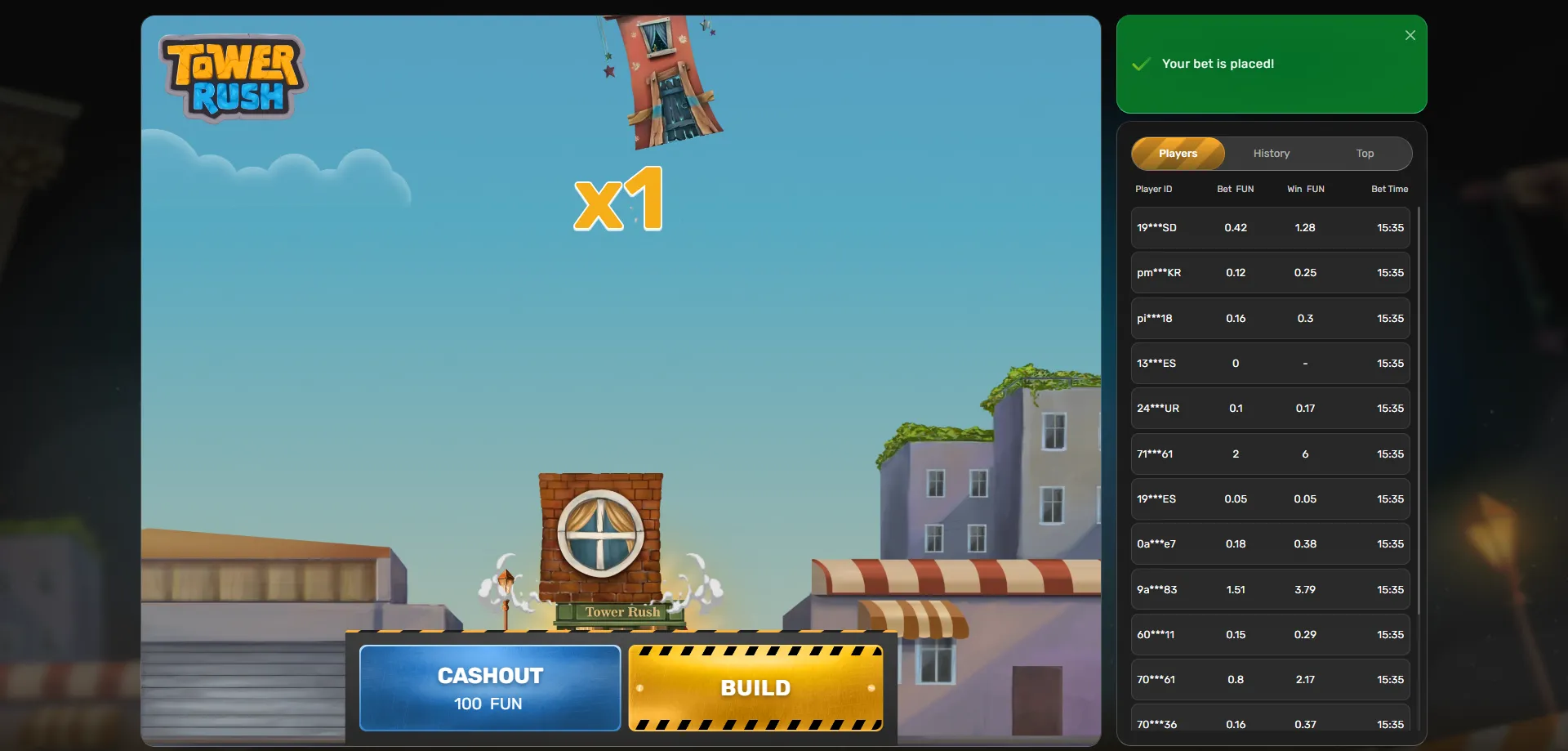
A round begins when players confirm their stake. The tower then starts building upward, and a multiplier rises from 1× in real time. Players monitor the climbing figure and press the cash-out button when they are satisfied with the multiplier on screen. If the tower collapses before they cash out, the stake is lost.
"Tower-up" refers to the phase where the multiplier is actively climbing and floors are being added. "Crash" is the moment the tower collapses, ending the round. Any player who has not cashed out before the crash loses their wager for that round.
The collapse point is pre-determined by Galaxsys's certified RNG before betting even opens. The result is cryptographically sealed and cannot be altered once the round begins, ensuring neither the operator nor any player can predict or influence the outcome.
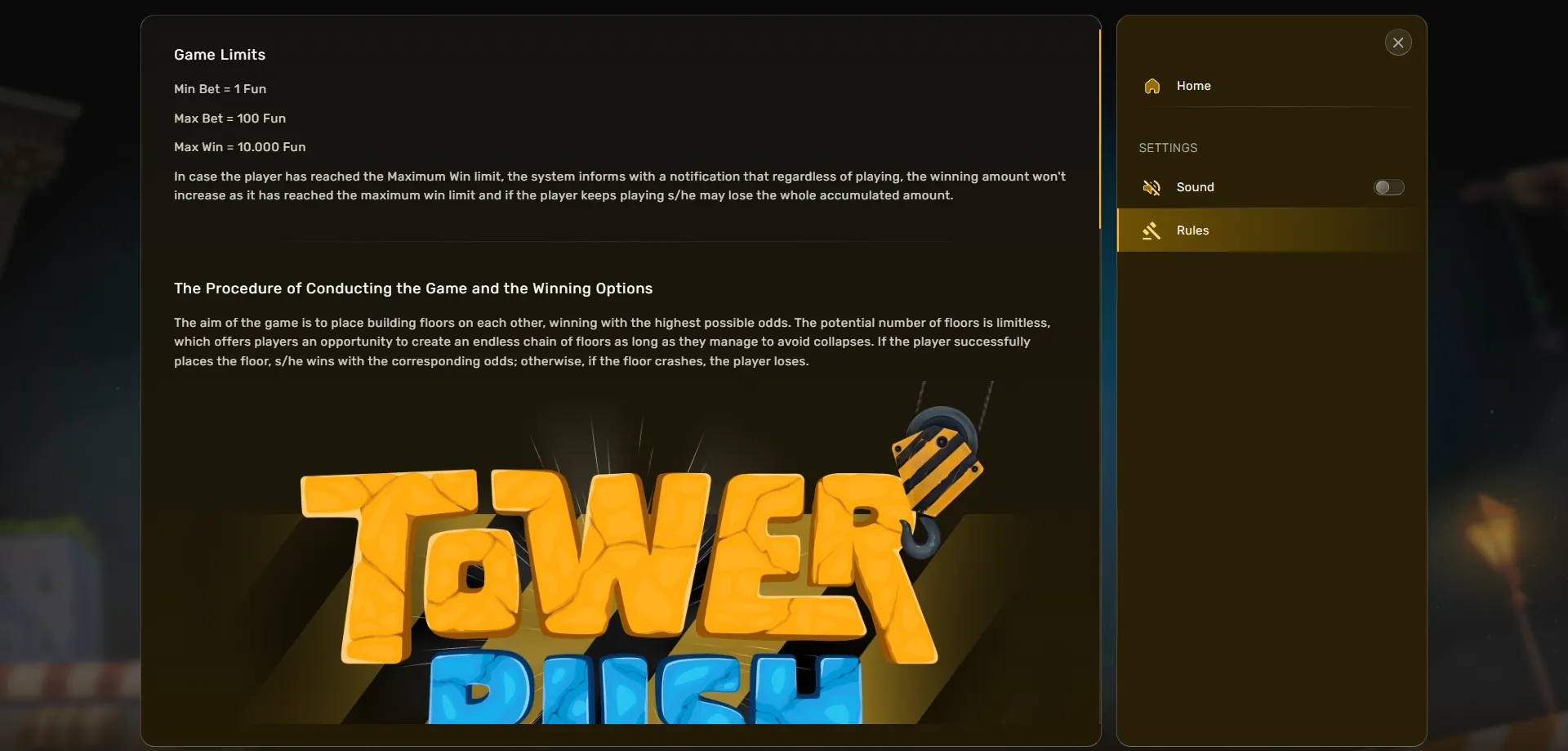
There is no fixed ceiling on how many floors the tower can reach in a single round, and the multiplier has no hard cap defined in the game's standard rules. However, a maximum win teaser of 50× has been referenced in promotional materials. In practice, most rounds end well before extreme heights.
The multiplier starts at 1× when a round begins and increases continuously as each new floor is added. The rate of increase is not fixed — it can accelerate at different points — which is part of what makes timing decisions difficult and exciting.
When you click "Cash Out," the game locks your exit multiplier at that precise moment. Your payout equals your stake multiplied by that figure and is credited to your account balance immediately, regardless of whether the tower continues rising or crashes shortly after.
Yes. Tower Rush is a multiplayer crash game. Multiple players participate in the same round simultaneously, each with their own stake and their own cash-out decision. You can typically see other players' activity in a live feed or leaderboard panel during the round.
If your connection drops during a round, the game's server-side logic continues running. If you had set an auto cash-out multiplier, the exit triggers automatically on the server. Without an auto cash-out set, you risk losing your stake if the tower collapses before your connection is restored.
Bet limits are set by the casino hosting the game rather than by Galaxsys directly. At most India-compatible platforms, the minimum bet is between ₹10 and ₹50 per round. Maximum bet limits vary by casino and account tier.
Tower Rush offers both. In manual mode, you click "Cash Out" yourself when you choose. In auto mode, you pre-set a multiplier threshold, and the game exits automatically when that level is reached — removing emotional pressure from the equation.
The addition of three unique bonus floors — including the Frozen Floor, Temple Floor, and Triple Build — gives Tower Rush mechanical layers that most crash games lack. These randomly triggered features add variety and strategic depth beyond a simple rising multiplier.
Individual rounds can last anywhere from a few seconds to considerably longer, depending on how high the multiplier climbs before the crash. Short rounds are common given the game's high volatility, but no fixed time limit applies to any individual round.
The combination of a 97% RTP, three distinct bonus floor types, provably fair verification, and polished mobile performance puts Tower Rush ahead of many crash competitors. The bonus floors in particular add strategic variety that pure crash titles typically do not offer.
Most rounds conclude within seconds, though higher-multiplier rounds can stretch longer. The format is designed for fast, repeated play — which is both its appeal and a reminder to set firm session limits.
The visual design is clean and modern. A tower rises floor by floor against a structured backdrop, with smooth animations that clearly communicate multiplier growth. The design is deliberately uncluttered so players can focus on the multiplier counter without distraction.
Yes, fully. Tower Rush runs natively on both Android and iOS browsers, and a dedicated Android APK is available at select casino platforms. The interface scales cleanly to smaller screens, with touch-friendly controls that work without precision difficulty.
Yes. The game includes audio feedback — tension-building sound effects as the tower rises, and distinct crash sounds when a round ends. Most platforms allow you to toggle sound on or off according to preference.
Yes. Tower Rush includes three unique bonus floors — the Frozen Floor, Temple Floor, and Triple Build — which are triggered at random by the RNG. Each modifies the round in a distinct way, adding a layer of unpredictability that keeps gameplay fresh.
Payouts are calculated by multiplying your stake by the multiplier at your cash-out point. The result is credited instantly to your casino balance. There are no delayed calculations or waiting periods for standard round payouts.
Tower Rush, as a Galaxsys title, is built to be hosted only on licensed casino platforms that carry responsible gaming tools such as deposit limits, session timers, and self-exclusion options. Players should use these tools proactively given the game's fast pace and high volatility.
Yes. The game uses a provably fair RNG system. Each round's crash point is generated before bets are accepted, and the outcome is cryptographically sealed. Players can independently verify individual round results using the seeds provided by the system.
A live player panel typically displays other participants' bets and the multipliers at which they cashed out during each round. This social element adds competitive tension — seeing a fellow player exit at 20× while you are still holding is both inspiring and nerve-testing.
The atmosphere is tense, fast, and focused. The rising tower builds genuine suspense, and the clean interface ensures nothing distracts from the core decision: hold or exit. It rewards composure more than excitement-driven impulse.
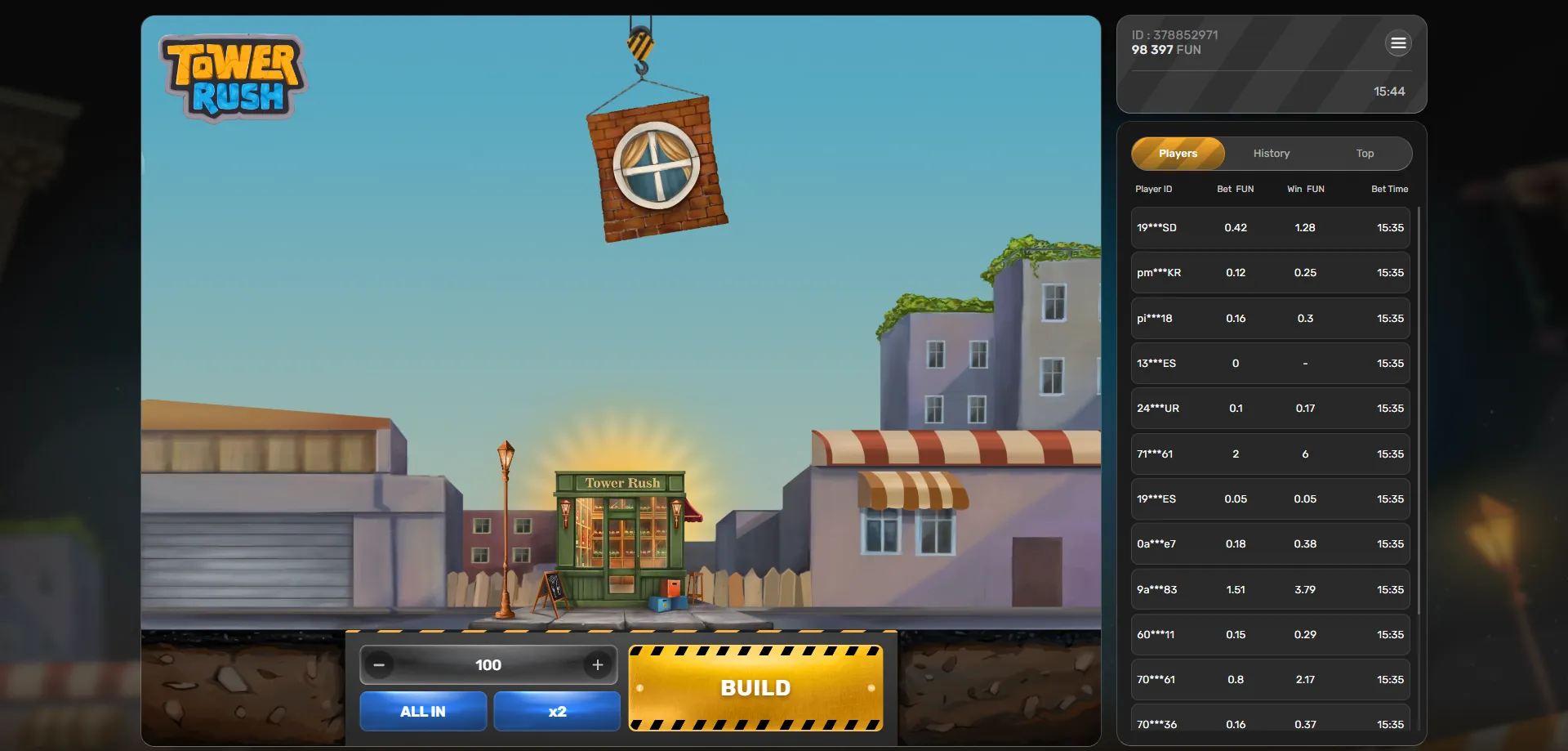
Register at a licensed online casino that carries the Galaxsys game catalogue. Once logged in, navigate to the crash games section, open Tower Rush, select your stake, and wait for the next round to begin. The process takes under a minute from sign-up to first bet.
Real-money play requires a registered and funded account. Some casinos also offer a demo mode that is accessible without registration, allowing you to practice with virtual credits before committing any funds.
Confirm your bet before the round opens. If you are using auto cash-out, set your target multiplier at this point. Once the round starts, the tower begins rising and your only remaining action is to decide when to press "Cash Out."
Pressing "Cash Out" locks in your winnings at the current multiplier and removes you from the round. Your payout — stake multiplied by that multiplier — is credited to your balance immediately. You cannot cash out after the crash point has already been reached.
Rounds vary in length. Some collapse within two or three seconds at low multipliers; others climb for a minute or more. There is no guaranteed minimum or maximum duration, which is central to the game's suspense.
If the tower collapses before you press "Cash Out," you lose your entire stake for that round. There are no partial refunds for late reactions unless a Safety Floor bonus is active at the crash point.
Yes. The current multiplier is displayed prominently on screen throughout the round, updating in real time. You can also see your potential payout (stake × current multiplier) as the tower climbs, which helps inform your exit decision.
Focus on the multiplier counter and your pre-set target. Avoid watching other players' activity too closely, as it can trigger impulsive decisions. Stick to your strategy and use auto cash-out if you find manual timing emotionally difficult.
Bet adjustments are made using the stake controls in the betting panel before each round. Most platforms offer quick-select buttons (e.g., 2×, 5×, Max) as well as manual input fields. Bet amounts must be confirmed before the round begins.
Both modes are available. Auto mode lets you set a cash-out multiplier target and a recurring bet amount, with the game managing exits on your behalf. Manual mode keeps you in full control but requires your active attention throughout every round.
Yes, via the demo mode available at many casinos. The demo replicates the full experience using virtual credits, with no real money at risk. Availability without registration varies by platform.
After a round concludes, a brief interval separates it from the next. If you have placed an auto bet, a new wager is queued automatically. If playing manually, you confirm your next bet during the interval. Results from the previous round remain visible briefly on screen.
No strategy guarantees consistent wins because the crash point is determined by a certified RNG. However, disciplined bankroll management and conservative cash-out targets can sustain a session budget longer and reduce the impact of losing streaks.
The most widely recommended approach is setting a fixed auto cash-out multiplier — typically in the 1.5×–2× range — and maintaining consistent bet sizes. This produces frequent small wins while limiting exposure to high-multiplier losses. Limiting individual stakes to 1%–3% of your session budget also helps manage variance.
There is no objectively "best" time because the crash point is random. The practical answer is: cash out at the multiplier you set as your target before the round began — not when you feel tempted to hold longer. Pre-commitment prevents impulsive overreach.
Risk management is arguably the most influential factor in Tower Rush outcomes. Players who set strict per-round limits and cash-out thresholds preserve their bankroll through volatility and avoid the catastrophic session losses that come from chasing high multipliers repeatedly.
Martingale (doubling after a loss) and Paroli (increasing after a win) can be applied to Tower Rush bets, but both carry significant risks given the game's high volatility. A streak of early crashes can exhaust a bankroll rapidly under Martingale. If you experiment with these systems, apply them only with a capped loss limit.
Bonus floors — Frozen Floor, Temple Floor, and Triple Build — add favourable modifications when they appear, which can make rounds where they trigger more rewarding. However, they appear randomly, so you cannot plan a round around their presence.
Emotional decisions are among the largest sources of loss in crash games. Holding too long because a round "feels lucky," or increasing bets after a loss out of frustration, are patterns that consistently erode bankrolls. The auto cash-out feature exists specifically to counteract these impulses.
Small multipliers (1.5×–3×) offer higher frequency of success but modest individual returns. Large multipliers (5×–20×) offer larger single-round payouts but come with much higher loss frequency. Your choice should depend on your risk tolerance and session budget size.
No. The crash point is fixed by the RNG before the round begins and is not predictable from visual cues, timing patterns, or historical data. Any claim to predict crashes reliably should be treated as misinformation.
Practice in demo mode builds familiarity with the game's rhythm and helps you develop a cash-out discipline before real money is involved. It will not improve your ability to predict outcomes, but it will improve your ability to stick to a strategy under pressure.
New players should start in demo mode, use conservative auto cash-out targets, and treat their first real-money sessions as an extension of learning rather than profit-seeking. Small, consistent bets at low multiplier targets are the safest entry point.
Reflexes matter at the margins — a slow manual reaction can cost you a successful cash-out if the crash arrives quickly. Using auto cash-out eliminates this factor entirely, which is why most experienced Tower Rush players prefer it for disciplined play.
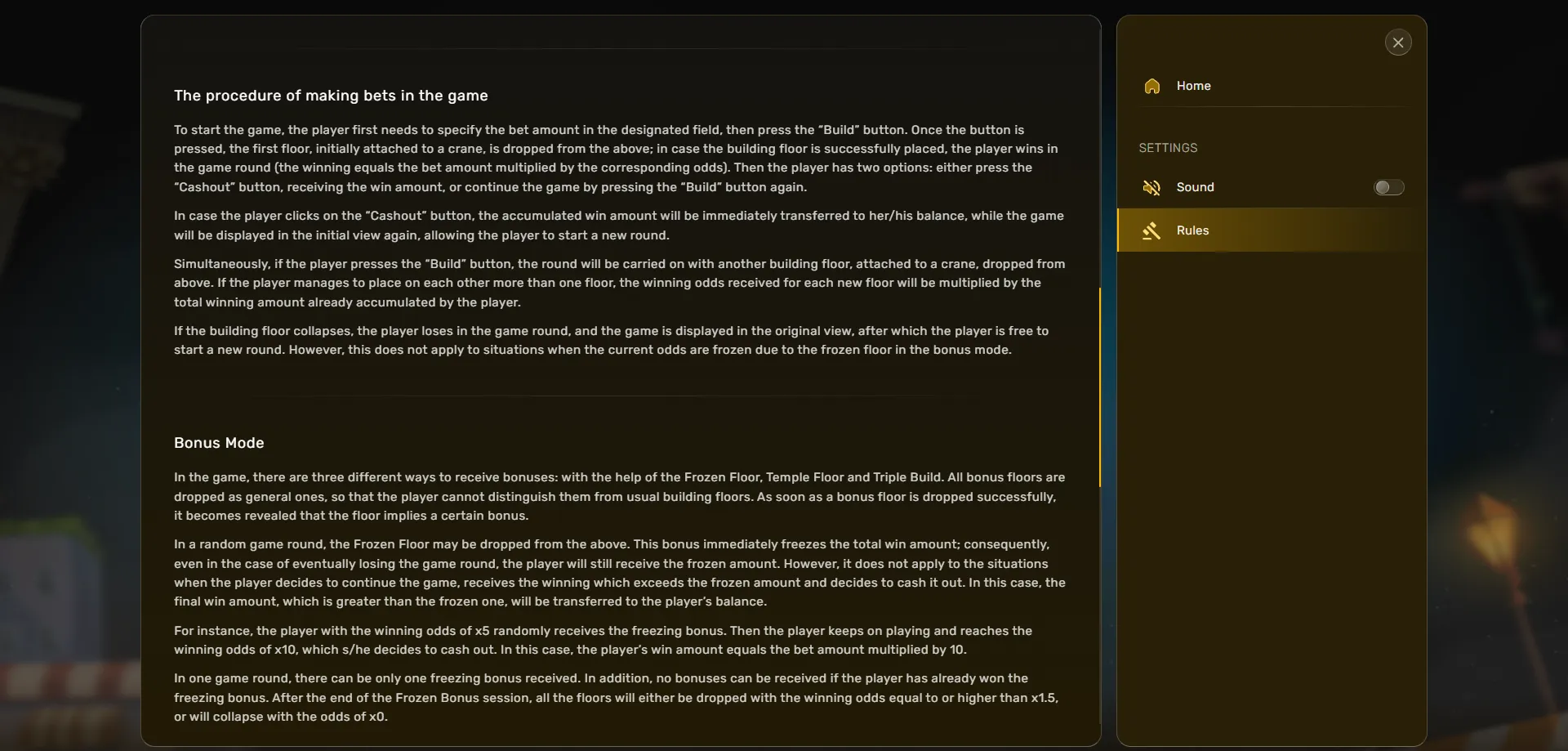
Bonus floors are randomly inserted into rounds by the RNG. When the rising tower lands on one, a special effect activates — such as freezing the current multiplier (Frozen Floor) or boosting it (Triple Build). These cannot be triggered deliberately but can significantly improve a round's outcome when they appear.
The golden rule of Tower Rush: always cash out before greed overrides your plan. Set your target before the round begins, use auto cash-out to enforce it, and never adjust your target upward mid-round because the multiplier "looks like it has further to climb."
Bonus floors are special floors that the tower can land on during a round, triggering effects that modify gameplay in the player's favour. They are exclusive to Tower Rush and represent one of the key features that distinguish it from standard crash games.
Tower Rush features three unique bonus floor types: the Frozen Floor, the Temple Floor, and the Triple Build. Each delivers a different gameplay effect and strategic implication.
The Frozen Floor acts as the game's safety mechanism. When triggered, it freezes the current multiplier state, protecting players from losing their stake if the tower collapses at that point. It effectively gives players a reprieve during a round that would otherwise end in a loss.
When the tower lands on a multiplier-boosting floor such as Triple Build, the active multiplier receives an accelerated increase. This can push the multiplier significantly higher than the natural climb rate would achieve in the same timeframe, offering a stronger payout for players who remain in the round.
Your displayed multiplier jumps or climbs faster than normal for a period. Players who have not yet cashed out benefit directly from this acceleration. Those who already exited before the boost floor was reached do not receive its benefit retroactively.
Bonus floors are entirely random, triggered by the same certified RNG that determines the crash point. They cannot be predicted, manipulated, or reliably anticipated. Their appearance varies across rounds with no fixed frequency.
Specific stacking rules depend on the game's internal logic, but in general, multiple bonus floors can appear in a single round if the tower climbs sufficiently high. Each floor triggers its own individual effect as the tower passes through it.
Their unpredictability means you cannot build a strategy around expecting a bonus floor to appear. However, knowing that a Safety Floor can occasionally protect your stake might encourage slightly more aggressive hold targets at the margin — though relying on this is not recommended practice.
The Frozen Floor can act as a safety net under certain conditions, protecting your position if the crash occurs at that floor. However, this is random and should never be counted on as a reliable loss-prevention mechanism.
Yes. All bonus floor types are available in the demo version, as it replicates the full real-money RNG environment using virtual credits. This means you can experience and learn from bonus floor events without financial risk.
Galaxsys has not publicly disclosed exact frequency data for bonus floor appearances. In practice, they appear with enough regularity to be meaningful gameplay features but not so often that every round contains one. Their rarity is part of what makes them exciting when they do appear.
The best approach is to treat bonus floors as a welcome surprise rather than a planned event. Maintain your standard strategy and cash-out discipline regardless of whether a bonus floor appears. If one does trigger, it enhances your round — but your baseline plan should never depend on it.
Yes. The game's built-in bonus features include the three bonus floor types (Frozen Floor, Temple Floor, Triple Build), the auto cash-out and auto bet tools, and the provably fair verification system. These are part of the game itself and available at every casino that hosts it.
Mission systems, if available, are administered by the casino platform rather than the game itself. Some casinos running Tower Rush include daily or weekly challenge boards that reward players for achieving specific milestones within the game — check your casino's promotions page for details.
Achievement and badge systems are casino-side features, not universal across all Tower Rush implementations. Where available, badges are typically unlocked by completing milestones such as reaching a specific multiplier, playing a certain number of rounds, or using auto cash-out features consistently.
Yes, provided the bonus is a real-money bonus (not a demo credit) and the casino's wagering requirements are met. Casino welcome bonuses and reload offers can be used to fund Tower Rush bets, subject to any game contribution rules the operator applies to crash titles.
Tower Rush does not use free spins in the traditional slot sense. However, some casinos may offer free bet credits or bonus balance that can be staked on Tower Rush rounds, which functions similarly in practice.
Progression systems are a casino-platform feature, not part of the base game. VIP programmes and loyalty tiers at the hosting casino may reward regular Tower Rush play with elevated status and perks, but these vary entirely by operator.
At casinos where progression is tied to round volume or wagered amounts, players who stake consistently benefit more from reward accumulation. This naturally aligns with disciplined, sustained play rather than erratic high-stake sessions.
No. Demo mode uses virtual credits that cannot be converted to real money. Casino bonuses apply only to real-money accounts. The game mechanics are identical, but the financial reward dimension exists only in the real-money environment.
Whether you can stack multiple bonuses in a session depends entirely on the casino's terms. Some operators allow sequential bonus activation; others restrict one active bonus at a time. Check the promotions terms at your chosen casino before attempting to claim multiple offers.
Cashback offers, loyalty points, and some reload bonuses at casinos are proportional to wagered amounts, which means higher bets generate more reward value. However, responsible play should always take priority over chasing bonus accumulation through elevated stakes.
Galaxsys maintains partnerships with licensed casino operators, which ensures Tower Rush appears on reputable platforms that typically offer competitive loyalty and bonus programmes. Playing at a well-established partner casino usually means a more comprehensive rewards ecosystem than a smaller, less-established operator.
Some casinos run tournaments and leaderboard competitions specifically around crash-format games including Tower Rush, where players compete for top positions based on multipliers achieved or volume played over a set period. These events are operator-organised rather than built into the base game.
The multiplier is a number that starts at 1× when a round begins and increases continuously as the tower builds upward. It represents the factor by which your stake will be multiplied if you cash out at that exact value. A 3× multiplier on a ₹100 stake yields a ₹300 payout.
Multipliers increase automatically as each floor is added to the tower during a round. The rate of increase is not linear — it can accelerate and decelerate — and bonus floors can trigger additional jumps in the multiplier value.
There is no fixed hard cap stated in the game's core mechanics, though promotional materials reference a 50× maximum win teaser. In practice, most rounds end at much lower multipliers due to the game's high volatility.
Payout = Stake × Cash-Out Multiplier. For example, a ₹200 stake cashed out at 4.5× returns ₹900. No additional fees or calculations are applied to Tower Rush payouts by the game itself — though withdrawal fees may apply at the casino level.
Payouts from successful rounds are credited to your casino account balance instantly upon cash-out. Withdrawing those winnings to your bank account, UPI, or e-wallet follows the casino's standard withdrawal processing times and requirements.
The multiplier mechanics and RNG system are identical in both versions. The only difference is that demo winnings use virtual credits and cannot be withdrawn as real money.
Yes. Because Tower Rush uses a provably fair system, the crash point — and therefore every payout — is determined by a verifiable cryptographic process. The calculation is transparent and consistent, with no room for post-round manipulation.
No. The multiplier is a function of the round's RNG outcome, not the size of your stake. A larger stake means a larger absolute payout at any given multiplier, but it does not affect the multiplier value itself.
The game's core multiplier mechanics are consistent because they are baked into the Galaxsys game engine. However, the RTP figure can vary slightly by operator configuration, which can subtly affect the distribution of multiplier outcomes over large sample sizes.
The majority of rounds resolve at multipliers below 5×, with a meaningful proportion crashing below 2×. High multipliers in the 10×–50× range do occur but are infrequent by statistical design — this is what defines the game's high volatility.
No multiplier is mathematically "safe" because each round is an independent RNG event. However, statistically, lower cash-out targets (1.5×–2×) succeed more frequently than higher ones, making them lower-risk choices even though individual round outcomes remain unpredictable.
Nothing negative — your payout was already locked in the moment you clicked "Cash Out." Subsequent events in the same round, including an immediate crash, have no effect on your credited winnings.
Multipliers are the entire reward mechanism of the game. Unlike slots where symbols determine prizes, in Tower Rush your only variable is at what multiplier you exit. Every decision, strategy, and outcome in the game flows through this single, constantly changing number.
Demo mode is a free-play version of Tower Rush that uses virtual credits instead of real money. It replicates the full game experience — including RNG mechanics, bonus floors, and multiplier behaviour — without any financial risk to the player.
The demo is available at online casinos that host the Galaxsys game library. Some platforms allow instant free play without registration; others require an account before granting demo access. A search for tower rush game kahan se download karen or the casino's game page will point you to available platforms.
On some casino platforms, yes. Instant-play demo access is offered without account creation, though this varies by operator. Casinos that require registration for demo access typically do so to verify age and location compliance.
The only functional difference is the currency: demo mode uses non-redeemable virtual credits. The RNG system, multiplier mechanics, bonus floor frequency, and visual experience are identical. You cannot win real money in demo mode.
Demo mode is the ideal environment to test and refine strategies — trying different cash-out thresholds, experimenting with auto vs. manual exits, and building an intuition for the game's volatility rhythm — before staking real money.
Yes. Galaxsys uses the same certified RNG engine in both demo and real-money versions. This means the statistical properties of the game — including volatility and bonus floor frequency — are consistent across both modes.
No. All winnings in demo mode are virtual credits with no cash value. They cannot be withdrawn, transferred, or exchanged for real money regardless of how large a virtual balance you accumulate.
Most casinos automatically restore the demo credit balance when it runs low, or offer a manual reset button within the demo interface. If the balance runs out without an auto-reset, simply refreshing the game page typically restores the default demo credit amount.
Yes. Bonus floors are part of the base RNG system and appear in demo rounds just as they do in real-money play. This makes demo mode genuinely useful for understanding how bonus floors work before risking real stakes.
Yes. The demo version runs on the same mobile-optimised engine as the real-money game. It is accessible via Android and iOS browsers without any download or additional software.
Demo play lets you understand the game's volatility, test cash-out strategies, and develop discipline around auto cash-out settings — all without financial risk. Players who skip demo mode and go straight to real money often underestimate how quickly high volatility can deplete a budget.
Yes. As long as you access it through a reputable, licensed casino website, the demo version carries no financial risk and no data security concerns beyond those of any standard online platform.
RTP — Return to Player — is a percentage indicating how much of the total money wagered on a game is theoretically returned to players over millions of rounds. Tower Rush has an RTP of approximately 97%, meaning the game returns around ₹97 for every ₹100 wagered in aggregate over the long term. It does not guarantee any individual session result.
The base RTP is approximately 97%, but the precise figure can vary slightly depending on how individual casino operators configure the game within the Galaxsys system. Always check the information panel within the game at your specific casino for the exact applicable RTP.
Volatility describes the variance of outcomes. Tower Rush is classified as high volatility, meaning that wins can be large but are less frequent, and losing streaks — especially early crashes — can occur in rapid succession. This makes bankroll management essential.
High volatility suits the crash format because it creates the high-multiplier potential that makes the genre exciting. A low-volatility crash game would offer predictably modest outcomes and far less of the tension that defines Tower Rush's appeal.
Tower Rush uses a provably fair system developed by Galaxsys. Each round's crash point is generated by a cryptographic hash before bets are placed and cannot be altered mid-round. Players can verify this independently after each session.
No. The provably fair system ensures that the crash point is sealed before bets open. Neither the operator nor any third party can alter the outcome after the fact. The casino can verify results but cannot change them.
After completing a round, you can access the round's cryptographic seed data from the game's information panel. Entering this data into the verification tool confirms whether the crash point matches the pre-round hash, proving the result was not altered.
The collapse point is determined entirely by Galaxsys's certified RNG algorithm, which generates a crash multiplier before each round opens for betting. This value is independent of bet volumes, player count, previous round outcomes, or any external input.
No. RTP is a long-term statistical measure across millions of rounds and all players combined. It does not guarantee profit for any individual player over any session or time period. The high volatility means individual results can deviate significantly from the 97% figure across shorter play windows.
The same RNG engine and provably fair protocol operate in both demo and real-money versions. The statistical output is identical. This consistency is what makes demo mode a reliable testing environment.
Galaxsys submits its RNG and game mechanics to independent testing laboratories as required by the licensing bodies of the casinos that host the game. Specific certification bodies are typically listed in the casino's compliance documentation or the game's information overlay.
Data security is the responsibility of the licensed casino platform hosting the game. Reputable operators use SSL encryption for all data transmission and comply with GDPR or equivalent data protection standards. Tower Rush itself does not store personal or financial data independently of its host casino.
The combination of a verifiable provably fair system, a competitive 97% RTP, and hosting exclusively through licensed casino operators gives Tower Rush a strong foundation of trust. The transparency of its mechanics — every round outcome is independently verifiable — is a meaningful guarantee that very few online casino games can match.
Before committing to real-money play, it is worth exploring the platform more broadly. The Tower Rush Bonus page details current welcome offers and free spin promotions, while the full Tower Rush Review covers licensing, payment options, and the complete player experience in depth.
Register through cm2inch.com today to secure a matched deposit bonus and 50 free spins on the hottest slot games.
Play Now🔒 18+ · T&C Apply · Play Responsibly